Moonfade Blog
Does Moonfade fade audio before or after the countdown ends?
Understand Moonfade’s conditional ending: countdown, enabled fade and audio-focus request, then a separate enabled display-lock request. Check actual player and screen results.
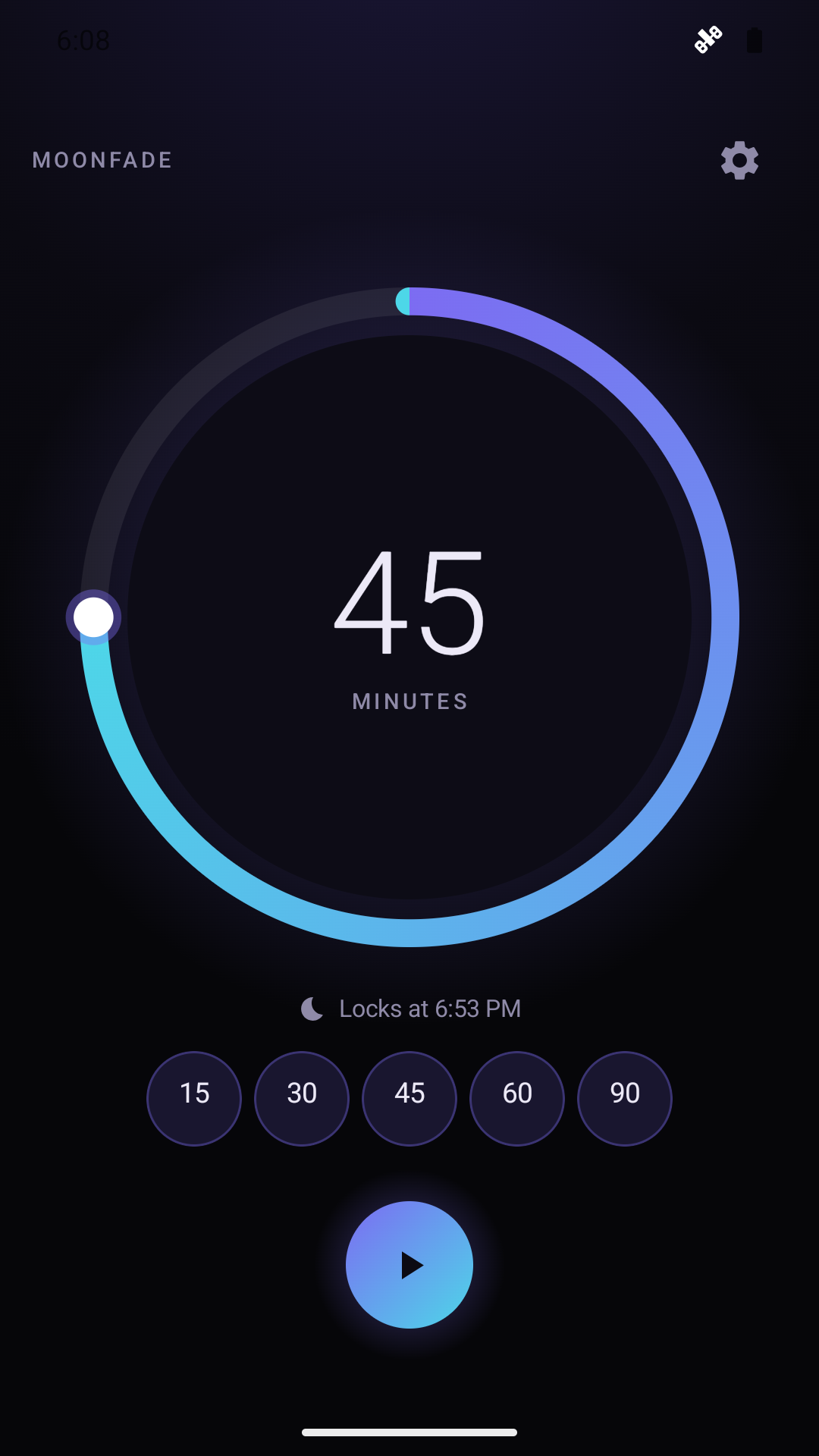
With Stop audio & video enabled, Moonfade fades media volume after the countdown ends, not throughout the countdown. The fade can last from 0 to 60 seconds, and the playback request follows that ending stage. Include the selected fade interval when deciding when to check whether your player has paused.
The Moonfade feature guide describes the sequence as countdown, media-volume fade, then a request for playback to pause. Separating those stages makes the timer easier to understand, especially when the countdown reaches zero but you can still hear the end of the fade.
The complete conditional ending
The normal configured sequence is: countdown → enabled media-volume fade → audio-focus request to pause playback → separate enabled display-lock request. The selected fade interval is 0–60 seconds; zero skips the gradual interval. Moonfade waits for the audio stage before requesting display lock when Turn off the screen is enabled.
If Stop audio & video is disabled, Moonfade skips both the fade and audio-focus request. An enabled display-lock request remains a separate action after countdown completion. Device Admin activation before an in-app Start remains required by the current release; it does not mean every ending action is enabled.
This describes requests and their order, not guaranteed physical results. An accepted audio-focus or lock request does not prove that the player paused or the display actually locked. Inspect those results on your own phone.
Walk through a concrete example
Suppose you enable Stop audio & video and choose a 15-minute countdown and a 30-second fade. During those 15 minutes, the timer counts down. Reaching minute 15 begins the separate 30-second media-volume fade; it does not mean Moonfade has already spent the last 30 seconds gradually fading the sound.
After that interval, Moonfade makes the playback-ending request. In this example, the sequence extends to roughly 15 minutes and 30 seconds from the timer's start before you assess the player's response to the completed ending. The actual player response remains dependent on your Android device and media app.
This distinction is useful when you expect to hear the full countdown at your chosen volume. It is also useful when planning a time at which you want to inspect the outcome: checking exactly at countdown zero is earlier than checking after the fade.
The countdown setting answers one question
Your chosen duration answers: how long should the timer wait before beginning its ending behavior? Moonfade supports a countdown from 1 minute to 24 hours, selected with the dial or a quick preset. Choosing a longer countdown does not automatically mean a longer fade.
Think of a 30-minute countdown and a 10-second fade as two separate choices. The first defines the waiting period. The second defines the gradual volume reduction after that period. If you change the countdown, inspect the fade setting separately rather than assuming one is calculated from the other.
For a first timing check, choose a short countdown you can watch. Start playback in your usual media app, select the duration in Moonfade, tap Start, and complete the required Device Admin activation when prompted before the countdown begins. This keeps the test tied to your real listening setup.
The fade setting answers another question
The fade length answers: how gradual should the media-volume ending be once the countdown has finished? A positive value provides an additional fade interval. Setting zero removes that gradual interval, while leaving the countdown as a separate stage.
A zero-second fade should therefore not be interpreted as a zero-minute timer. Likewise, a 60-second fade does not add a minute to the number shown as your selected countdown. It adds a separate ending interval after the countdown reaches its end.
When comparing two fade choices, keep the countdown and player the same. First observe a short positive fade, then another selected value. Changing the timer length and media app at the same time would make it harder to identify which choice explains a different result.
Check volume and playback separately
Lower volume is an audible change, but pause is a change in the player's playback state. A player can be difficult to hear while its progress still advances. After the fade completes, inspect the player rather than using silence as the only sign that playback stopped.
Moonfade Support explains that Moonfade lowers the Android media-volume stream and requests audio focus. It recommends enabling Stop audio & video and testing your chosen media app. Those instructions do not promise that every player will pause the same way.
Display lock is another separate outcome. Device Admin access is used for turning off and locking the display, so a dark screen does not prove the audio has paused. Record the volume, player state, and display result individually if an ending seems unexpected. Use the controlled player-response test to check the complete sequence; if playback continues, follow media-keeps-playing recovery.
To see the sequence for yourself, Get Moonfade on Google Play, choose a short countdown with a clearly observable fade, and inspect your player after both stages finish.