Moonfade Blog
Moonfade vs YouTube bedtime reminder: which fits where you play your audio?
YouTube's bedtime reminder prompts you at a set time of day and can wait until a video ends, but it does not pause playback. Moonfade counts down from 1 minute to 24 hours, then with Stop audio & video enabled runs a post-countdown fade and an audio-focus pause request. Choose based on whether you act on a prompt or want an elapsed-time ending.
A YouTube bedtime reminder is an interrupt-and-dismiss prompt at a scheduled time of day; it does not stop playback on its own. Moonfade is a countdown-based Android sleep timer that, with Stop audio & video enabled, runs a post-countdown fade and then requests that playback pause. Choose the reminder when you want to be prompted and will act yourself; choose Moonfade when you want an elapsed-time ending you can adjust and, optionally, a separate display-lock request.
What each one actually does
YouTube bedtime reminder
According to YouTube's own help page, the bedtime reminder lets you set specific times when you want a reminder to stop watching and go to bed. You can have it interrupt your video or wait until the video ends, and you can dismiss it or choose Remind Me Again for another reminder in 15 minutes (YouTube Help).
The same page is explicit that a reminder is not a timer: it points to YouTube's sleep timer separately for readers who "want the video you're watching to automatically pause after a certain time." In other words, the reminder's documented scope is prompt-and-dismiss inside YouTube, with an optional wait-until-video-ends setting — not automatic playback stopping by the reminder itself.
Because the page describes the reminder as a YouTube setting, treat its behavior as belonging to YouTube. Do not extend those details to other apps, and do not assume the reminder reaches playback on a smart speaker, a cast session, or another player. This article only compares YouTube's reminder with Moonfade's timer on the actual stop-playback task; it does not claim what either does for casting or hardware it doesn't control.
Moonfade
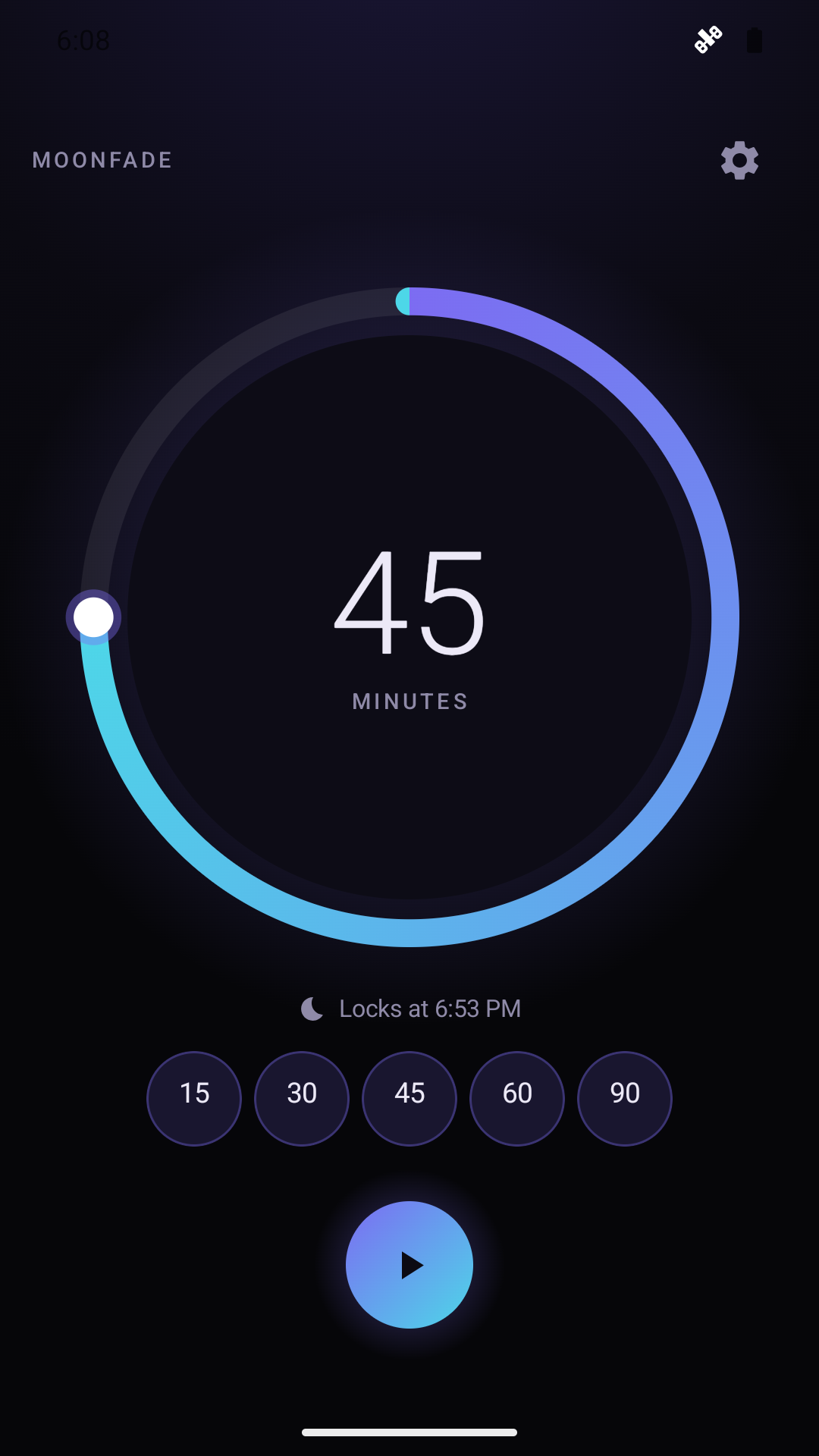
Moonfade is a sleep timer for Android 8.0 and later for music, podcasts, audiobooks, or video playing in another media app. You choose a duration from 1 minute to 24 hours with the duration dial, or use the five built-in presets (15, 30, 45, 60, or 90 minutes). With Stop audio & video enabled, the configured 0–60-second media-volume fade begins after the countdown completes, followed by an audio-focus request to pause playback. Whether a player actually pauses depends on the media app and the Android device (Moonfade).
Moonfade does not provide media and does not track sleep. It does not claim control over smart speakers, remote cast playback, or hardware power.
Elapsed time vs. a content boundary
This is the core decision. The two tools count different things.
- YouTube reminder: a time of day trigger. It can fire mid-video or wait for the video to finish; either way, the trigger is the clock or the video's end, and the outcome is a prompt you handle.
- Moonfade: an elapsed-time countdown from the moment you start it. It does not try to detect a chapter or episode boundary; it ends after the duration you set.
If your real need is "pause this YouTube video after roughly 30 more minutes," YouTube's own sleep timer is reviewed in Moonfade vs YouTube's Sleep Timer and is the more natural place to start when YouTube is your only player and a plain elapsed-time pause of that video is enough. If your real need is "remind me that it's bedtime and I'll close the app," the bedtime reminder is designed for exactly that.
Supported playback endpoint
Both tools are aimed at different endpoints:
- The reminder's documented endpoint is a notification-style prompt inside YouTube, which you dismiss or snooze. The video keeps playing until you act, unless you are using YouTube's separate sleep timer.
- Moonfade's endpoint, when Stop audio & video is enabled, is a media-volume fade plus an audio-focus pause request issued to whichever player is currently holding audio focus. That request can be accepted or declined by the app; testing your usual player is the only way to know.
Neither outcome should be confused with a display lock or with muting every phone sound. Moonfade's fade lowers the Android media-volume stream; it is not a system-wide mute. And a quiet player is not proof that it paused — check the player's own state.
Controls and permissions in Moonfade
If you choose Moonfade, the in-app flow is:
- Start playback in your media app.
- Open Moonfade and choose a duration with the dial or a preset.
- Tap Start, then complete any prompted Android Device Admin activation for screen lock before the countdown can begin. In the current version, the in-app Start flow requires activation rather than pre-activating it before tapping Start.
- Use the active timer notification to add time, subtract time, or stop the timer without reopening Moonfade.
Enable Stop audio & video in Moonfade Settings so the post-countdown fade and audio-focus request run. Turn off the screen is a separate display-lock request; it can still run when Stop audio & video is off, and it uses Device Admin. Turn Turn off the screen off before uninstalling if you want Moonfade to release its Device Admin access. If you cannot open the app, remove Moonfade from Android's device-administrator settings first; device-settings paths vary.
Which one, and when
- Choose the YouTube bedtime reminder when you only want a prompt at a chosen time, are watching in YouTube, and are willing to act on the reminder yourself. It is also convenient if you prefer to wait until a video finishes before the reminder appears.
- Choose YouTube's own sleep timer when the content is in YouTube and a simple elapsed-time pause of that video is sufficient. See the cross-linked comparison above.
- Choose Moonfade when the media plays in another Android app, when you want a configurable 0–60-second fade before the pause request, when you want to adjust the running timer from a notification, and when you optionally want a separate display-lock request. Because the pause request is player- and device-dependent, run a short test with your usual player before relying on it. A testing walkthrough is in Test Moonfade with your media player.
Keep the outcomes distinct: a reminder is a prompt, a finite queue ends on its own, a display lock turns off the screen, a media-volume fade lowers audio, and an actual playback pause is a separate state. The reminder does not perform the last two, and Moonfade does not guarantee the pause — it requests it.
A next step: decide whether your session needs a prompt or an elapsed-time ending. If it is the latter and your audio plays outside YouTube, confirm your Android version and player, then Get Moonfade on Google Play and set a short timer for one minute to observe how your player responds to the ending.